
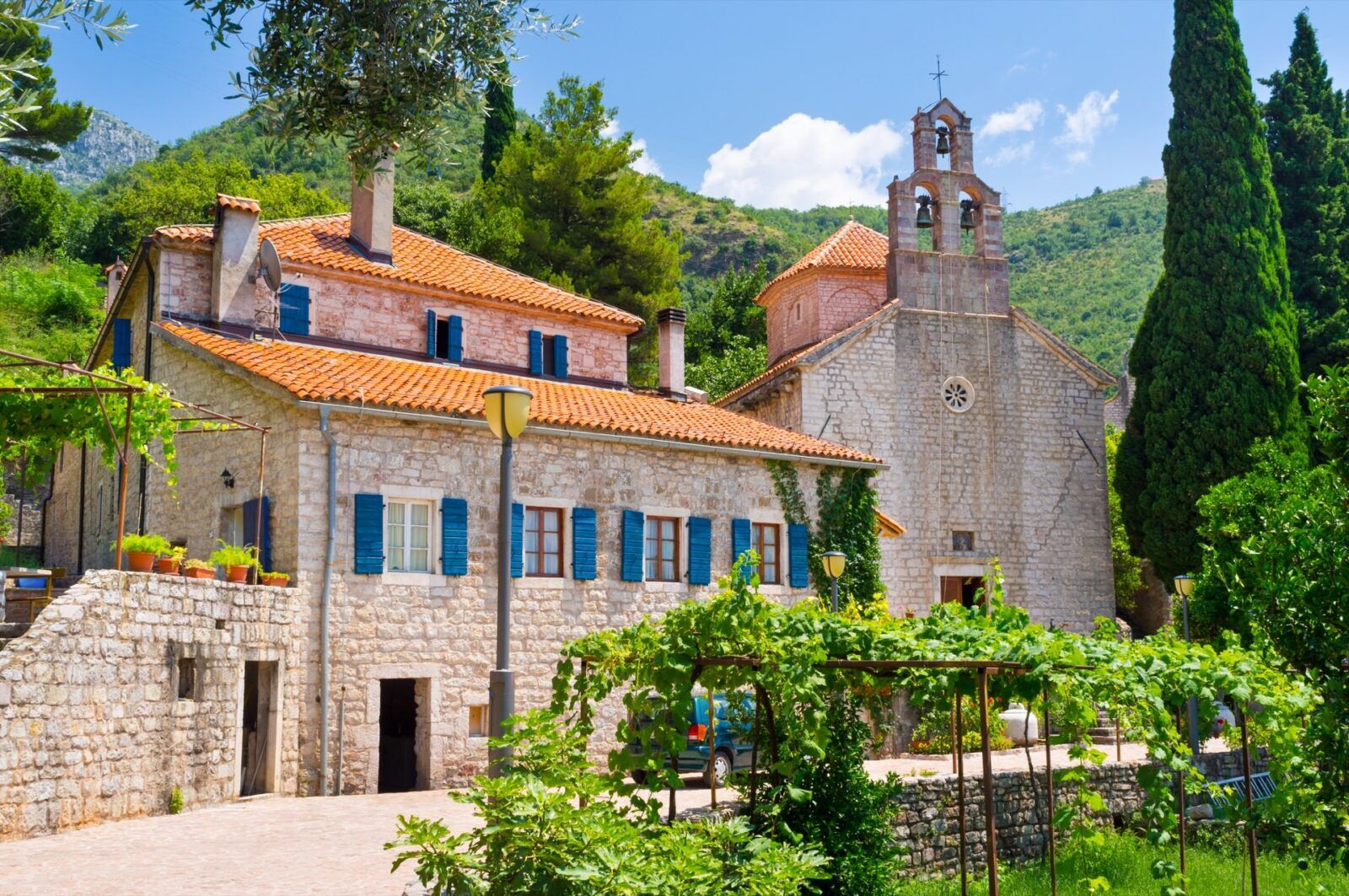
Praskvica Monastery
Praskvica Monastery is a historic Serbian Orthodox site near Sveti Stefan, founded around 1050 and named for a peach-scented spring. It features churches from the 15th and 17th centuries, frescoes, and valuable relics, offering a glimpse into Montenegro’s rich cultural and religious heritage.
History and Origins of Praskvica Monastery
The Praskvica Monastery is located on a hill above Miločer, not far from the well-known Sveti Stefan (St. Stephen). According to tradition, it was founded in 1050, though the first reliable data dates from 1307 when the Serbian king Milutin visited Kotor. This monastery got its name from a nearby spring whose water smells like peaches, which locals call “praske”. The oldest written records mentioning the Praskvica Monastery date from 1413, relating to gifts given by the Zeta ruler Balša III. Consequently, these early accounts highlight its long-standing significance in the region.
Main monastery church of Sveti Nikola (St. Nicolas) dates from the 15th century, as testified in a parchment. On its remains in the 19th century, a bigger edifice was built, which contains frescoes from the old church. The second monastery edifice is on a hill, dedicated to Sveta Trojica (Saint Trinity), and dates from the 17th century. Its biggest artistic values are frescoes painted by zoographic painter Radul and the gilded iconostasis of Dimitrije Dasjak from the 17th century. Moreover, this blend of architectural styles showcases the monastery’s evolution over centuries.
Cultural Significance and Features
As part of the monastery, there are sleeping quarters and a former school where monks from Pastrovici taught children literacy. The church was significantly damaged in the 1979 earthquake but was restored, and many relics, icons, old manuscripts, and other documents are kept there. Also, in this monastery, you can find a manuscript Gospel in silver covers, which, as legend says, Bishop Danilo gave to people from Pastrovici. Indeed, these artifacts underscore the Praskvica Monastery‘s role as a cultural and educational hub.
What can be interesting for visitors is also a great stone table on which the Great Pastrovici court called “Bankada” used to hold sessions. This feature adds to the historical ambiance, making the Praskvica Monastery a compelling destination for those exploring Montenegro’s past.