
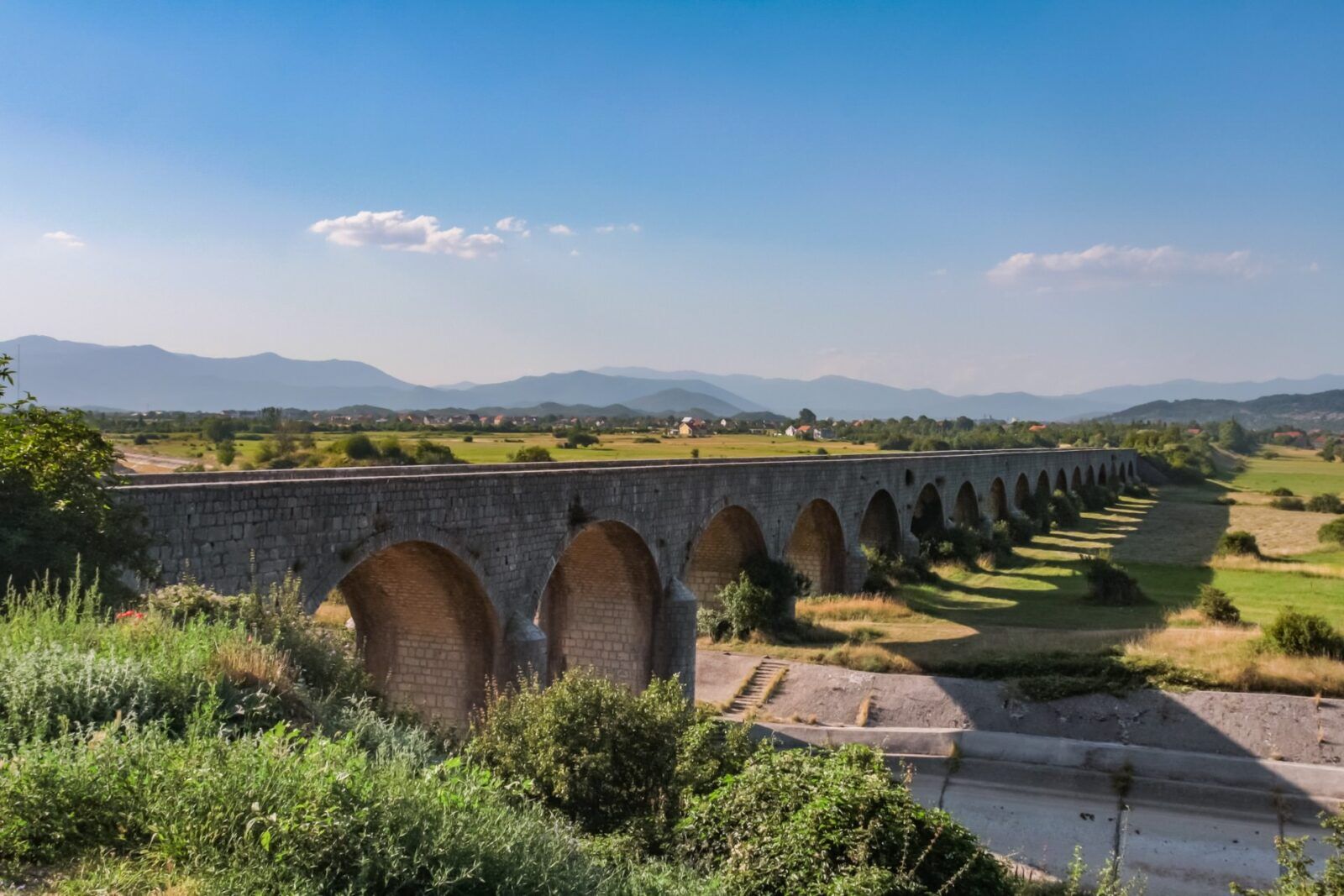
Tsar’s Bridge
Tsar’s Bridge (Carev most) on the Zeta River is one of Montenegro’s most impressive bridges, stretching 269 meters with 18 arches. Designed by Josip Slade and built in 1894, it was named after Russian Emperor Alexander III, who financed its construction. You’ll pass it on the old road from Danilovgrad to Nikšić along the Zeta River. This bridge was crucial for Montenegro’s development, enhancing trade ties in the Central Region.
Indeed, the bridge is much wider than the modern river channel due to a large backwater pool that existed in the past. Today, the river’s channel is straightened and strengthened with concrete, so only one span actually crosses the water. Under this highest span, a small pedestrian bridge now exists, adding to its unique character.
Moreover, Tsar’s Bridge is considered one of the most beautiful stone bridges in Southeast Europe. Built of cut stone in just six months, it features 18 large vaults. At its opening, Prince Nikola highlighted its importance and suggested naming it the Emperor’s bridge, cementing its historical significance.
Historical Significance and Construction
The Tsar’s Bridge was a monumental project that transformed Montenegro’s infrastructure. Designed by Josip Slade and completed in 1894, it spans 269 meters with 18 arches, making it a key engineering feat of its time. Financed by Russian Emperor Alexander III, it was named in his honor, reflecting the strong ties between Montenegro and Russia during that era.
Consequently, this bridge played a vital role in boosting trade and connectivity in the Central Region. By improving links with southern Montenegro, it facilitated economic growth and development. Prince Nikola’s emphasis on its importance at the opening ceremony underscored its value as a strategic asset for the nation.
Architectural Features and Modern Adaptations
Architecturally, the Tsar’s Bridge stands out for its 18 large vaults built from cut stone in just six months. This rapid construction showcases the skill and efficiency of the builders. The bridge’s width exceeds the modern river channel, a remnant of a past backwater pool that once influenced its design.
Today, the river channel has been straightened and reinforced with concrete, meaning only one span crosses the water. Under this highest span, a small pedestrian bridge has been added, allowing for safe foot traffic. This adaptation preserves the bridge’s functionality while maintaining its historical charm.
Location and Visitor Experience
Located along the Zeta River on the old road from Danilovgrad to Nikšić, the Tsar’s Bridge is easily accessible for travelers. Passing by this structure offers a glimpse into Montenegro’s rich history and engineering prowess. Its scenic setting makes it a picturesque stop for those exploring the region.
For visitors, the bridge provides an opportunity to appreciate both its aesthetic beauty and historical context. As one of Southeast Europe’s most beautiful stone bridges, it attracts history enthusiasts and photographers alike. Its enduring presence continues to inspire awe and admiration.