
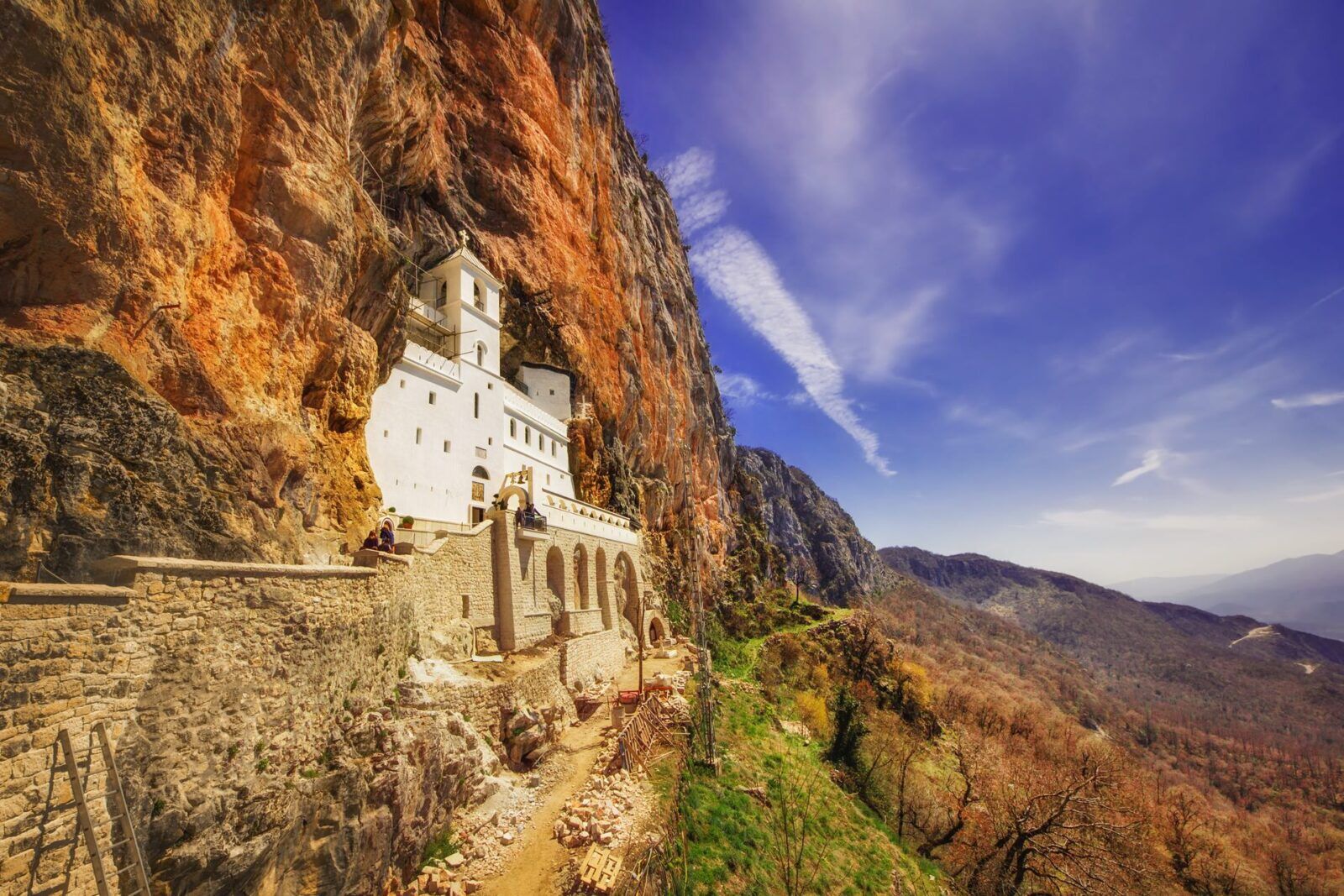
Ostrog Monastery Cultural Heritage
Ostrog Monastery is a revered Serbian Orthodox site in Montenegro, renowned for its cliffside location and as a spiritual center housing the relics of Saint Basil of Ostrog, attracting pilgrims and visitors for its profound cultural and historical significance.
Architectural and Historical Significance of Ostrog Monastery
The history of the monastery Ostrog, well known to the reader by now, is still a secret in the Ostrog cliffs. Even though its history is well preserved in human memory so that it will not be forgotten, its cultural and artistic treasures tell a story of this most memorable place for the southern Slavs. The Upper monastery, above the header of the inside entranceway of the church “Holy Crucifix,” carries an inscription: “By the will of God, the sacrifice of the Son and the will of the Holy Spirit this church named by the holy Crucifix was build in 1773, and finished 1775 with the blessing of the saint hooded bishop Basil, with the hard work and perseverance of Isaiah, the grandson of the first holy prior Isaiah of Ostroga from the village of Pope. God bless them for starting and finishing.” The documented year of 1773 is calculated by the medieval telling of time, and the actual dates are 1665 for the start and 1667 for the end of the building process. The reason for this little church name is believed to be that a small piece of what is said to be the piece of Christ’s cross was given to the church when it was being built. Consequently, the altar became a place where a very important part of Christianity was displayed.
From the XVII century, the most treasured items in the monastery are the frescos in the cave part of the church in the Upper monastery. In place of the altar, the sanctified table was placed, and nearby in the rock, a hole was drilled.
Unique Church Design and Frescos
The church is abnormally placed for a church of these regions; the altar with the sacrificial table is placed in the southern part with the entrance in the north. The ceiling built in stone is uneven and slanted toward the south-east. The church itself is very small. On the north side, the wall is only 2.5 meters wide and the west is 4. The height of the ceiling at best is 4.5 meters at its highest point. The church light comes from three small openings that give enough light to see, but not too much as to give the feeling of mysticism. The altar on the southern side was divided by an iconostas that has throughout the monastery’s turbulent history disappeared, and only a wooden plank that held it from east to west of the church is still visible.
The frescos of the church are very well preserved considering the time since their creation. They cover every wall of the church and are in good condition, bearing in mind that the stone they are painted on is often very moist. The content of the frescos is typical for frescos of the times, where furthermore in places where the wall was exceptionally uneven, flower ornaments were painted. On the west wall, the saints Jovan Zlatoust and Basil the Great are depicted. A number of them depict the resurrection of Christ, the baptismal of Lazar, and the entrance of Christ into Jerusalem. In the third area are frescos depicting the big Christian holidays – Christmas and Easter. There are also icons of four well-known Christian figures: Aaron, Moses, Samuel and Jeremiah.
The items of the frescos are common for all small churches of the XVI and XVII century. Only the unevenness of the church wall created some uncharacteristic changes to the usual artistry. Some elements are drawn smaller so the artistry had to be more precise than usual to keep the intended theme of the fresco. The holy cross has been painted twice in the small church along the side of the door with inscribed cryptograms – the first letter of words that formed sentences written on the Cross Christ was crucified on. The main artist was the same, Radul, but the mastery of the crosses was painted by the artist Jovan, the most famous Serbian painter of the post-Byzantine era. Moreover, the other wall frescos are the works of the well-renowned artist of the XVII century, Radul. He is also the one that the works of the prayer room frescos are attributed to.
Other Churches and Treasures of Ostrog Monastery
The church Vavedenje, that now contains the remains of Saint Basil, is known as the most holy ground of Montenegro and Herzegovina. This church was created as an addition to the smaller church already located there. The altar is on the east side of the building. This church is not more than 280cm tall. With the help of two small and one larger opening, the only other light comes from the very low-headed door. The iconostas that is located on the east side is a relatively new structure. This church is also richly decorated in frescos. On the walls are the faces of Saint Basil of Ostrog, the Serbian Saint Sava, Saint Jovan Zlatoust and a number of other grand Christian leaders.
The remains of church Saint George are located a couple of hundred meters above the Lower monastery. Surrounding it is a small cemetery. The church was burned to the ground by the Turks in 1770 during one of their attacks on the Bjelopavlic valley. Through time, natural influences such as earthquakes demolished what remained of the church. Only the fact that it was a small, one-room structure is recognizable of the church, and it remains a monument of the destructive powers of mankind and nature.
Preservation and Legacy of Ostrog Monastery Cultural Heritage
The turbulent history of the monastery Ostrog during four long centuries contributed that many treasures were destroyed by fire, taken by thieves, or ruined in time. Today, Ostrog contains only a small amount of the riches it was known to have had in past times. Some of these riches can be found in churches in Pljevlje, Mostar, Bliskovu-a small village by the city of Bijelo Polje, Podgorica and many other places on the Balkan. Be that as it may, a large number of antiquities still exist in both the Upper and Lower monastery. There is exceptional worth and beauty in the icons given to the monastery from all over where the Serbian people live: from Crete, Russia and the Holy Land. The most precious is the icon of Saint Nicola dating back to the middle of the XVII century. There is a collection of four fingers of martyrs in a richly decorated silver box. The monastery used to possess a large collection of old scripts and books that have also been reduced with time. Just before the Second World War, a rarely found copy of Oktoiha from 1494 was preserved. From its handwritten collection, only one book remains today written in the XVI century. Unbelievably beautiful and very well written, this book also carries the scars of the flames of the past. Indeed, no matter how many material riches have come and gone through the monastery, its richness is mostly valued on a spiritual level.
Learn more about Monastery Ostrog
-
Churches dedicated to Saint Basil of Ostrog
-
Ostrog Monastery Construction
-
Ostrog Monastery Cultural Heritage
-
Ostrog Monastery History
-
Ostrog Monastery Holidays and Gatherings
-
Ostrog Monastery Legends and Myths
-
Ostrog Monastery Location
-
Ostrog Monastery Stories of Miracles
-
Ostrog Monastery Traditions
-
The History of the Ostrog Region
-
The Life of Saint Basil of Ostrog
-
The prayer to Saint Basil
-
What others say about Ostrog Monastery